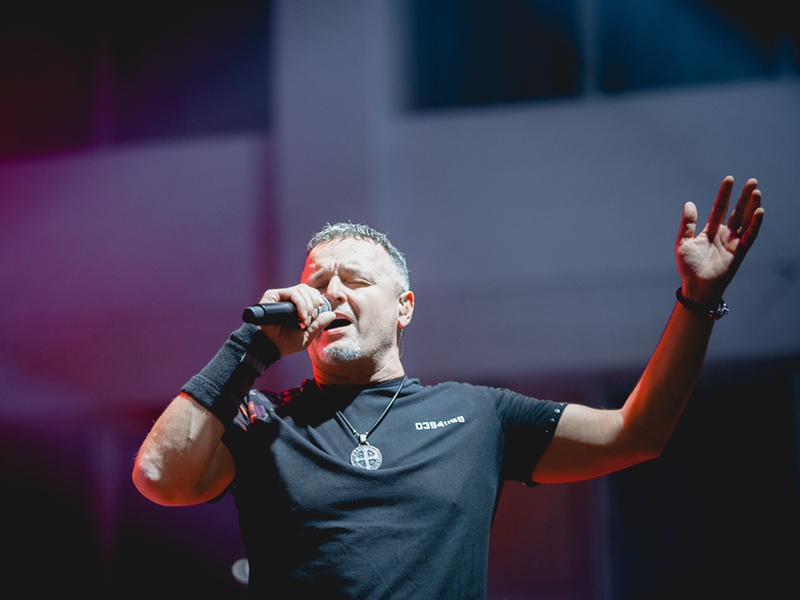
This summer has been very monumental for Croatia.
On July 5, Croatian rock musician Marko Perković Thompson performed in front of a sold-out concert attended by over 504,000 people at the Zagreb Hippodrome, the largest and most attended ticketed concert in the world. The crowd came from multiple regions in Croatia, Bosnia and Herzegovina, and from various countries in the Croatian diaspora. During celebrations of the 30th anniversary of Operation Storm, Sinj was also greeted with another spectacular concert by the patriotic singer on August 5 in front of 150,000 adoring fans clad in black t-shirts, berets, and Croatian red, white, and blue checkered flags.
Both concerts had heavy police and firefighter presence and recorded a minuscule number of incidents and interventions. Thompson’s team released a statement on Facebook, thanking all the hundreds of thousands for showing true unity and community demonstrated through their behavior. “Thank you for your patience, togetherness, and an atmosphere that exceeded all expectations. Your behavior and mutual respect showed the strength of your love for music and your country in the most beautiful manner possible.”
The Facebook post emphasized the strenuous hard work and dedication to organizing a concert on this scale and resulted in an audience reaction that was “something rare”. The mass gathering wasn’t an angry mob with soccer club hooligans. It was a relatively peaceful mass gathering of people who came out not because they were fans of Thompson’s music, but as a moment of shared identity, unity, and an unforgettable memory.
“Our goal for this event was to emphasize unity over division, drawing together citizens across a broad social and generational spectrum. Marko’s message throughout the night focused on shared heritage, national memory, and the enduring values of family, faith, dignity, and identity.”
These values are cherished in a majority of Thompson’s songs, including “Ustani iz sjene” (Come out of the Shadows), Moj Ivane (My John), and Lijepa Li Si (Beautiful You Are), which have significant themes of boldness in patriotism and admiration of faith, dignity, and unity. Songs like “Bojna Cavoglave” (Battalion Cavoglave), a song that has faced controversy for decades over its use of the centuries old military chant “Za Dom – Spremni!” (For Homeland – Ready), is a testimony to the Croatian people’s immense bravery, sacrifice, and struggles of Croats defending their homes from Serbian aggression, and the preservation of Croatian identity during the Homeland War in 1990s.
What resonated with the attendance was Thompson’s brave call for Croatians and all Europeans to return to their Christian roots. “You have come from all parts of Croatia,” Thompson cries. “We all share values, love for family, and our homeland. I would like to say that you return to your roots and traditions, that we return to our Christian roots.” Midway through the concert, retired Bishop Mons. Ante Ivas recited the “Maranatha” prayer to the crowd. The Maranatha is an ancient phrase mentioned once in 1st Corinthians, which translates in Aramaic to “O Lord, Come” as a prayer for the early return of Christ.
What made the concert uniquely special was the drone show that captivated attendees and onlookers in both Zagreb and Sinj. The drone shows during the July and August concerts illuminated the sky with thousands of drones, forming images of angels, the Virgin Mary with a heart-shaped rosary, and a large cross. The reactions of thousands of young attendees singing along tearfully and hands raised, glorifying God and the Virgin Mary, and singing along to Thompson’s hit song, Neću Izdat Ja (I will never betray you).
This summer has brought attention to the celebration of Croatian patriotism and a reawakened spirit that is divinely inspired. Despite the mountains of negative press against Thompson, devastating storms in the Dalmatian coasts, demographic crisis in the country, polarization, and labor shortages, the concert professed a deeper connection to the heartstrings of a spirited form of patriotism, reminding all Croats to heal together to keep love of family, faith in God, unity, and country.
Just like Croatians, Americans also have a dedicated patriotism that honors and cherishes their turbulent war for independence, built on the foundations of liberty, freedom, Judeo-Christian moralities, and the pursuit of happiness. Croatia, too, has a compelling history of numerous struggles for national sovereignty and recognition while enduring numerous conflicts, foreign occupation, and persecution. Croatians have been successful in forging their statecraft through democratic independence from a bloody conflict while deepening their relationships with the Catholic Church since the reign of King Tomislav in 925 AD. These events have shaped the Croatian people through their preservation of national unity, faith that intertwines with the culture, and historical significance to the region.
Thompson’s bold message is a reminder that Croatian and European societies are reawakening a deep and faithful connection to the divinity that has connected Croatia’s cultural identity for a millennium, but has been commonly suppressed in modern society. This spiritual reawakening resonates with the current Catholic revival that has ignited around the world, where the global Catholic population increased by 1.15% between 2022 and 2023.
Evangelization is taking root through social media of influencers, celebrities, and religious figures who use the internet and new age mediums to effectively communicate in what Bishop Barron identifies in This is My Body: A Call to Eucharistic Revival, the three transcendentals: the good, the true, and the beautiful, and connect with implications of the Eucharist. Social media is now revealing its advantage to share photos and videos of Thompson’s concert to a larger audience, proclaiming the message that motivates devotion to the divinity of Christ’s body.
As of 2025, 83.2% of the population in Croatia is Catholic, a slight decline over the past decade. However, communities of young and old are gathering for pilgrimages, congregations, solemn and feast masses, and eucharistic processions for national public holidays for religious devotion and tradition, like Velika Gospa.
A week earlier, before the massive concert, the Catholic Bishops of Croatia led a nationwide solemn consecration to the Sacred Heart of Jesus, marking the 125th anniversary of a similar ceremony in 1900. The small nation of 4 million people saw an astonishing 160,000 young Croatians filling churches, chapels, and the solemn mass to pledge their devotions at the Church of Our Miraculous Lady of Sinj, in the town of Sinj. On the following Saturday, the consecration was followed by Croatia’s first-ever solemn consecration of youth to the Immaculate Heart of Mary at the Church of Croatian Martyrs in Udbina.
From late July and early August, more than 50,000 youths and 700 priests around the world gathered for the 36th Annual Youth Festival at the Shrine of Our Lady of Medjugorje in Bosnia and Herzegovina for prayers, healing, and spiritual worship. Thousands of international flags, especially Croatian flags, were raised in joy and praise to eucharistic hymns, and evening prayers connected with the central theme of Psalm 122, “Let us go to the house of the Lord.”
Pope Leo XIV attended the final mass in the Youth Festival and encouraged young Catholics to ignite the flames of their hearts and unite together as one flame to experience the journey as a pilgrim. The Pope also stated, “On the path of life, no one walks alone. Our paths are always intertwined with those of others: we are made for encountering and walking together to a shared goal.”
A spiritual revival is taking shape among young people who are leading the charge to hold Bible studies and prayer groups. Instead of cultural motions, young people in the West are returning by conviction. They are replacing radical individualism, debauchery, pride, and materialism with ancient prayers and hymns that have guided Western civilization for centuries.
Although heavy metal concerts might seem like an unorthodox observance place, Thompson’s songs and drone shows brought attention to the country’s young people on how they should lead the country and to never forget their national and religious roots in a broken world. These concerts not only entertain intricate light shows and firework displays, but also heal a nation submerged in economic uncertainties, internal instability, corruption, geopolitical pressures, and complex historical dynamics. The reasons for the revival among young people are reflected in these trends.
First, Christianity is intertwined in Croatian society. Croatia’s turbulent history has been dominated by Habsburg influences, Ottoman occupation, nazi and communist indoctrinations. For centuries, the Catholic faith has always been a beacon for freedom and a bulwark for the Croatian people to endure the sufferings of occupation, war, and massacres in Jasenovac, Široki Brijeg, Bleiburg, and Vukovar. After three decades of independence and integration into the European Economic Community and the NATO Alliance, Croatian society is strongly proud of its national identity and Catholic roots that have guided its ancestors for over a thousand years. National holidays with Catholic significance, like Velika Gospa (the Assumption of Mary), are declared public and regional holidays by the government. Locals generally enjoy a day of relaxation, mingling with friends and family, and largescale precessions. The Catholic faith is not a privatized religion. It is professed publicly and to the overall community.
The second reason is the sense of community and unity. What surprised everyone in the media was the massive attendance of young people at Thompson’s concerts, which broke world records with no critical incidents reported. However, not everyone who attended came from Croatia. Over half a million attendees came to Zagreb from multiple regions in Bosnia and Herzegovina, Montenegro, and other countries with significant Croatian communities from Germany, Austria, Switzerland, Sweden, Canada, the USA, and Australia. Attendees displayed their love for their ancestral homeland and their faith through their Croatian and Herzegovinian flags with the names of their region stitched. Pilgrimages to Medjugorje and Sinj also display similar flags to represent the various regions and countries.
The third is disillusionment with Western progressivism. Dominated by communism for five decades, Croatia, over the last decade, embraced neoliberal ideals of globalism, identity politics, nihilism, and moral relativism that often demonize ethnic national preservation and identity. In contrast, Catholicism offers values rooted in morality, clarity of purpose, and national identity. Croatian bishops in the past often resisted Pope Francis’s progressive stances, focusing on migration, climate change, and historical reinterpretation of identity. Although what they offer is inclusiveness and individual freedom, it leaves people spiritually adrift and isolated. Through Thompson’s concerts, pilgrimages, and solemnity masses, Croatian Catholics are finding purpose with their faith intertwined with a source of purpose, community, and moral direction.
Recognizing Croatia’s cultural significance to the Church, sense of community, and disillusionment with progressivism are the few reasons why half a million young people would gather together for either a rock concert, solemn masses, pilgrimages, or retreats in the sweltering summer heat. The Croatian society has survived centuries of war, repression, and trauma, and thrives as a community of various counties and regions, with Croatian culture and faith preserved. Without a shared sense of truth, glory for beauty, and purpose, nations will fall along with the previous regimes and ideologies that occupied and attempted to manipulate the Croatian people.
Croatian youths are experiencing a spiritual revival and patriotism for their country’s independence. Thompson’s concert delivered an important message to young people to rededicate their trust in God, Cardinal Stepinac’s principles for the country, and the Virgin Mary, known as Kraljica Hrvata (Queen of the Croats). Thompson’s concert was neither a neo-Nazi rally to motivate division nor a call to overthrow the government, as fear-mongering critics claim. It was a dedication to promote love and unity, while cherishing Croatia’s centuries-long struggle for national identity and independence by honoring King Tomislav, Zrinski-Frankopan, the Croatian Armed Forces during the Homeland War, President Franjo Tudjman, and a memorial to honor the victims of Tito’s crimes against humanity.
Yugonostalgia remains present in Croatian society and throughout Southeastern Europe. Although tame in nature for its promotion of unity, it has caused a cultural homogenization of secularism, social and familial dysfunctionality, and relativism in the guise of the term “Balkan” while ignoring the uniqueness of the former republic’s national identity and culture. Croatian culture has plenty to offer for its people and those interested in its unique faith, culture, and identity.
Marko Perković Thompson not only achieved his goal in emphasizing unity over division. He succeeds what previous artists like Vice Vukov attempted since 1971, who was blacklisted by the Yugoslavian officials from releasing a song “Tvoja Zemlja” (Your Country), about love of homeland and Croatian culture. Although they come from different singing repertoires and generations, both are legends who expressed a similar message of patriotism through love of country and identity, and a similar message to all Croats to never despair and always remember where their roots lie, despite facing backlash.
Young people are now viewing these messages as an answer to questions that Western postmodernism is failing to resolve. Churches are overflowing, renewed interest in traditional devotions and history that is growing in a country with a population the size of the U.S. state of Oregon. As young people are gathering together in the hundreds of thousands to pledge solemn devotion to Jesus, travel hundreds of miles to the Vatican for the 2025 Jubilee, and attend sold out rock concerts with an ancient Christian prayer recited, so is their hopes for a fruitful future to build families and lead their community through hardships committed to foundations built from a collective religious identity and love for homeland.
These trends are attractive to young people throughout the Croatian diaspora and also to everyday Americans who crave spiritual growth through a foundation that preserves and not destroy the values of family and love for country. Marko Perković Thompson, a war veteran, who has, like many, seen the unimaginable sufferings and misery that war has intrenched in the memory of war vets and innocent people, is part of a significant catalyst in Croatia’s revival in faith and patriotism to view hope for the future and trust in God. These concerts, along with masses, pilgrimages, and festivals, are ways to rectify a wounded generation affected by its own complex history, polarization, and ambiguities in the world.
Foto: Josip Durdov
Listen to Croatians Online here:
Croatian American Media Association Corp is a tax exempt organization under Section 501 c(3) of the Internal Revenue Code (EIN # 99-1591741). Your donation is greatly appreciated and will be used to support our mission. Your contribution is tax deductible to the full extent permitted by law.