Author: Mirena Bagur, Mag. Oecc., folklorašica and storyteller/Croatian culture
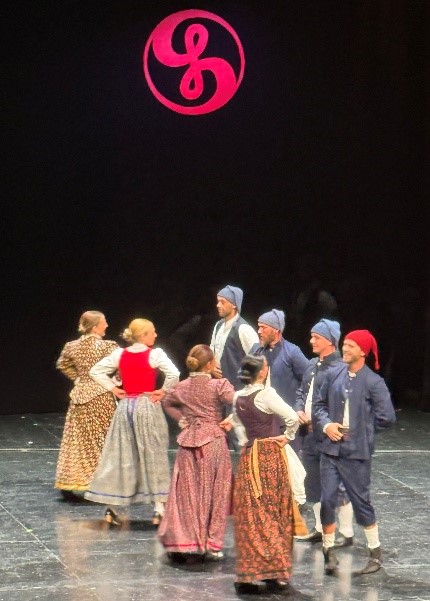
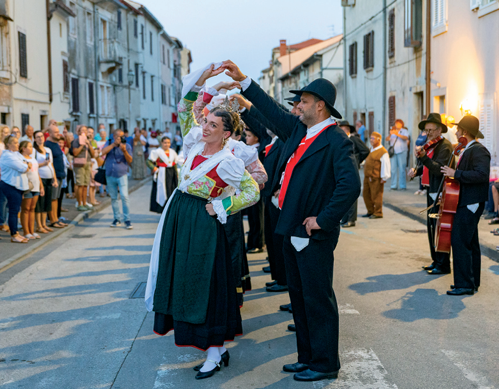
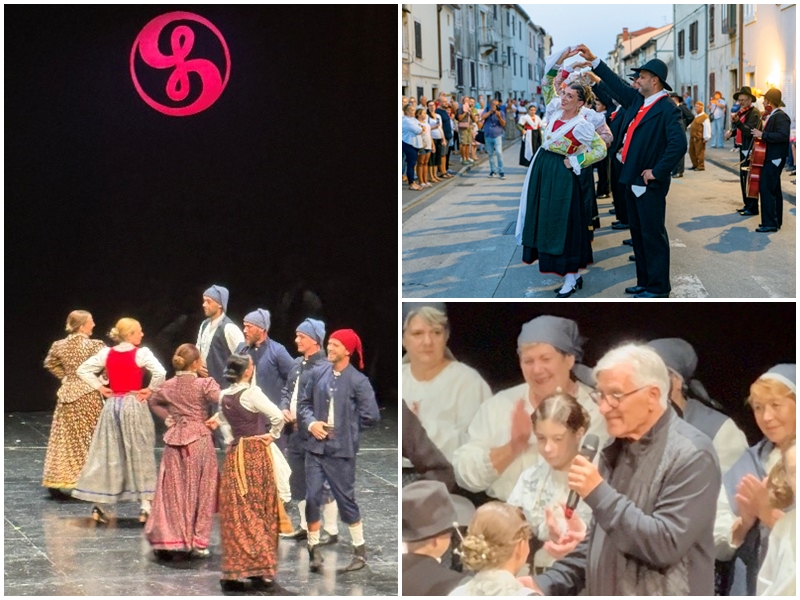
This is a personal perspective on a historic concert Let’s Dance Furlana! that recently took place in Pula/Pola, Istria. It sounds simple, yet for me it was a very complex experience that was developing over the last several years.
I am lucky to call the legendary Croatian ethno-choreographer Vido Bagur, my Dad. I am not going to describe the multi-decades of his work in the folklore field, (you can read that in his bio below), but focus on the last few years – I was listening to his various adventures in visiting Istria, Dalmatia and Italy in his search for remnants of a dance that was started in the Venice region – Furlana. Long story short, after attending various festivals and towns to research, meeting with groups, having numerous rehearsals with all, his production of the concert in Pula, under the sponsorship of the International Folk Festival Zagreb, was the culmination of the celebration of the dance that connected so many people united with the same dance.
For “folkloraši,” people who passionately participate in folk dancing, singing and keeping the culture alive, this was an evening to remember – for the first time ever the towns in which Furlana was danced over the centuries have been performed, and more importantly people from those areas have met and shared their versions. The camaraderie was obvious and contageous.
My pride in witnessing the first-ever concert of groups from many Mediterranean towns, was multidimensional – first, Croatia as a country stepped up in recognizing the importance of Italian communities in Istria — on September 11, 2024, the Croatian Ministry of Culture and Media concluded that Istrian furlanas, furlane istriane, those of Vodnjan (furlana dignanese) and Galižana (furlana gallesanese), are intangible cultural assets and included them in the Register of Cultural Assets of Croatia. The Institute of Folklore, under which the International Folk Festival in Zagreb has operated for 59 years, has dedicated celebration of this dance as part of this year’s celebration of the Traditional Culture and Identities — on the 1100th anniversary of the Croatian Kingdom.
This concert was organized in cooperation with the Istrian County, the City of Pula, the Pula Tourist Board, the Italian Union – Unione Italiana in Istria, the Italian Communities of Vodnjan and Galižana – Comunità degli Italiani Dignano e Gallesano, and the Association of Istrian County Folklore Groups. The groups participated included the “hosts” from Vodnjan and Galižana, and also Hvar, Korčula and Dubrovnik in Croatia; Aviano, Gorizia, Pomarolo and Val Resia from Italy; and Corfu, Greece. A gathering of people from towns on the Mediterranean connected with this dance, but also similar cultures.
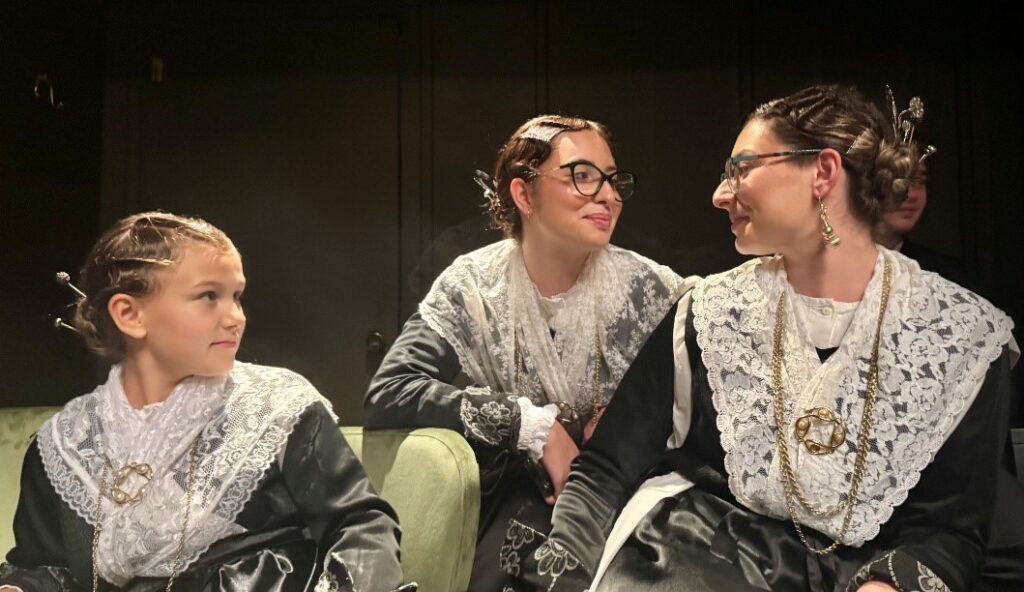
And, last and the most important to me personally — I am of course proud of my Dad, Vido Bagur. He spent several years researching the dances, meeting with people from all the groups in their home towns, and in some situations teaching them how to revive the dances. He worked with “Šaltin,” Folklore Group from the town of Hvar, and in Dubrovnik he just recently choreographed two versions at the Linđo ensamble – the elegant town version similar to contradance and rural choreographies, originally danced in Osojnik and Mokošica. Even to me as a daughter, it was impressive to observe Vido Bagur for not only dedicating the time and energy to this research over the years, but also at this concert, it was clear he transferred his excitement and passion to younger generations who are embracing this almost forgotten dance.
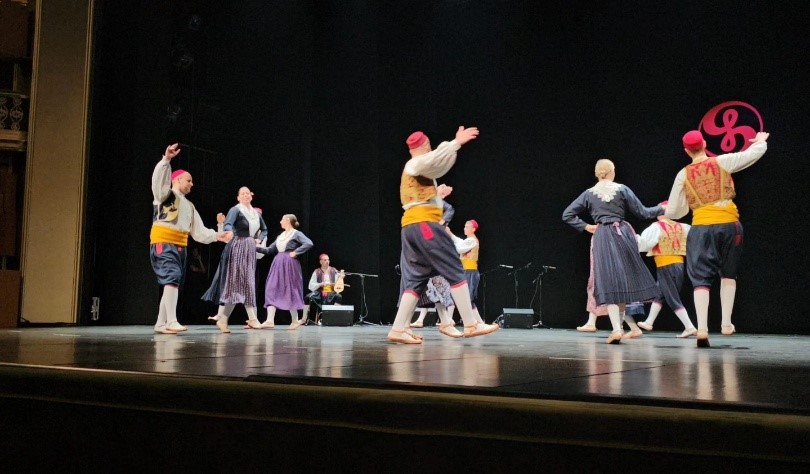
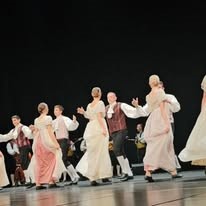
Behind the curtain, I also had the opportunity to rediscover camaraderie among the dancers – brought out memories of time when I danced in Metković and in Zagreb. In the festivals, by far the best experiences for participants are rehearsals and gatherings after the concerts for the conclusions, in this case the dinner for all where we all enjoyed the local cuisine and the Malvasia Istriana, the famous local wine. And I ran into dance colleagues from now in high places, like Tvrtko Zebec, assistant director of The Institute for Ethnology and Folklore Research and artistic director of Zagreb International Folklore Festival. And Vlaho Kljunak, general manager of the folk dance ensemble Linđo, Dubrovnik.
I proudly raise a glass of Croatian wine to Vido Bagur for his accomplishments over the years! In this case, his favorite — Muškat Momjanski. Živio! Salute!
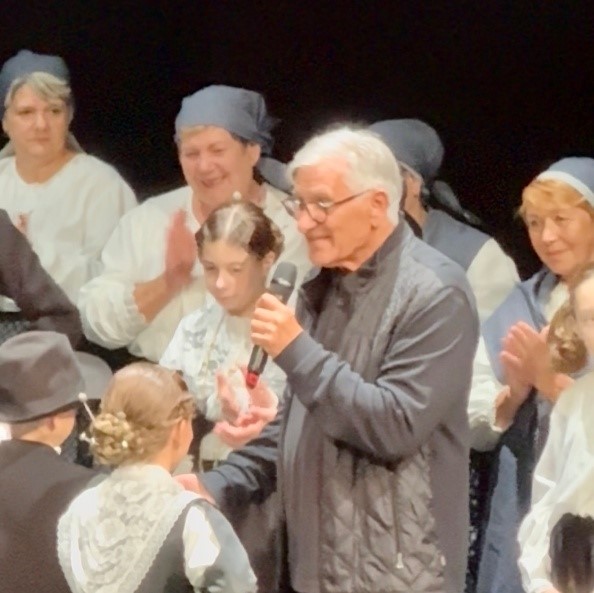
About the Author: Mirena Bagur, MBA, is the President of the New England Friends of Croatia, Board member of The National Federation of Croatian Americans Cultural Foundation and Co-Founder of Croatian Premium Wine Imports, Inc. She was born and educated in Croatia where she danced at KUD Metković and Joža Vlahović Dance Ensemble (now ZFA). While passionately promoting Croatia in the USA, including wine education, Mirena is thankful for her parents who instilled in her appreciation for the Croatian community, history and culture, for her children who love the Croatian culture, but lovingly mock her accent, and her husband who is her partner in crime.
Addendum:
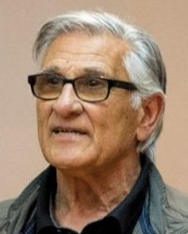
Here are excerpts from multi-year research about Furlanas – by Vido Bagur, and his short biography.
“The family of furlana dances contains numerous variations. They differ in musical accompaniment, are danced in almost all times and tempos, from slow to very fast, as well as with different dynamics. It has long been practiced mostly through staged performances, which resulted in many variations. In time, some groups adopted them as their tradition. The variations also happened through interventions of travelling dance teachers. It was common practice to adapt the style and musical accompaniment of a new dance to the existing local dance tradition.
During the time of the Republic of Venice, there were three areas on the Croatian coast of the Adriatic where furlana was adopted. It is interesting to note that each of those three areas developed two versions of the dance – an urban, ‘noble’ version, and the rural, ‘common’ furlana. The furlana danced in Istria, in the town of Vodnjan, is very elegant and accompanied by classical instruments – violin and violoncello (leron) – while the elegant dancing in Galižana is accompanied by older Istrian instruments, namely the bellows and tambourine (pive and simbolo). On the island of Hvar, the furlana was danced in villages. It was accompanied by a lijerica and the style and dancers’ posture were somewhat harder. They called it furlona. Men hopped around women, followed them with their arms spread, while the women waved their fans and flirted. In the town of Hvar, the urban variant was danced, in the form of a contredanse, accompanied by mandolins or an accordion, and known as the furlana.
In the city of Dubrovnik, the furlana was present in the salons, danced very elegantly to the accompaniment of a smaller mandolin ensemble in a contra dance formation. The dance was performed in couples, who danced prearranged figures as instructed by a dedicated dance teacher. The dance was elegant and constrained, with no frenzy, as the older gospars would say, while the ladies danced „as they pleased, with some charming flirting”. In other words, the dance was an occasion for courting. Furlana was danced in the areas surrounding Dubrovnik as well, but it was accompanied by lijerica, and its style was closer to the popular folk poskočica dance linđo. They called the dance furana.
Furlana is danced to duple, triple, and quadruple meter, and sometimes even a combination of those. Musical accompaniment most often consists of two 8-bar themes, but there are also various combinations. In urban traditions, this is an elegant and gracious salon dance without too much energy, but in the villages, the performances are full of temperament, energy and with strong accents. The accompanying instruments or musical ensembles vary across regions: diatonic accordion, piano accordion, small instrumental ensembles (accordion, clarinet, guitar, double bass), hurdy gurdy (vielle, zanfona, drehleier, ghironda), violin and cello, lijerica, solo mandolin or a mandolin ensemble, bagpipes and tambourine, and rarely accompanied by singing. It can be performed in couples with no contact between partners or with couples holding one or both of their partner’s hands, holding a flower or a bouquet, holding a kerchief or a larger scarf, or holding a hand fan. Sometimes the partners both hold a kerchief or a faux flower wreath.
The formations also varied: it could be performed in triads with a male partner dancing with two female partners; in quads of two pairs like a quadrille; in a line of couples in the contra dance formation; with couples forming a circle or with a couple alone in space.”
Vido Bagur, biography: Prof. Vidoslav Bagur, dance pedagogue and choreographer, is an expert associate and leader of significant Croatian folklore festivals (International Folklore Festival Zagreb and Folklore Festival of Dalmatia Metković). He is a lecturer at the School of Croatian Folklore but also spreads his knowledge beyond the borders of Croatia by teaching at many European dance schools, seminars and workshops. His many years of field research have encouraged the creation of many original folklore groups, festivals (Folklore Festival in Polača, Marian concerts in Metković, Meetings of Lijeričara and Zdravičara in Pridvorje) as well as the revival of forgotten customs (Kumpanija, Pupnat; Bijeli maškari, Putnikovići). He has specifically researched the following areas: Konavle, Župa Dubrovačka, Dubrovnik Littoral, Neretva Valley, Pelješac Peninsula, all Croatian inhabited islands, Zabiokovlje, Imotska, Sinjska and Drniška Krajina, the Poljica, Svilaje, Promina and Dinara areas, the Šibenik and Zadar coasts, Ravni Kotari and Bukovica, Western and Southern Herzegovina. He also conducts his field research among Croats living outside the borders of Croatia (Italy, Austria, Slovakia, Hungary, Romania, Bosnia and Herzegovina, Kosovo). He is a music editor and producer of several sound recordings and the author of the video for the book “Vila bana zvala preko Vrana” – Traditional clothing, songs and dances of Croats in Bosnia and Herzegovina in the 21st century, and a collaborator with Croatian Ratio Television on creation of folklore documentaries, including a most recent one about the Neretva region’s famous boat, Neretva lađa, Vozila se Neretvom Galija (watch on mobile app HRTi.)
Listen to Croatians Online here:
Croatian American Media Association Corp is a tax exempt organization under Section 501 c(3) of the Internal Revenue Code (EIN # 99-1591741). Your donation is greatly appreciated and will be used to support our mission. Your contribution is tax deductible to the full extent permitted by law.