RIT Croatia offers four programmes across two campuses, with tuition for European students set at €7,800 per year – less than a single semester at many private US universities.
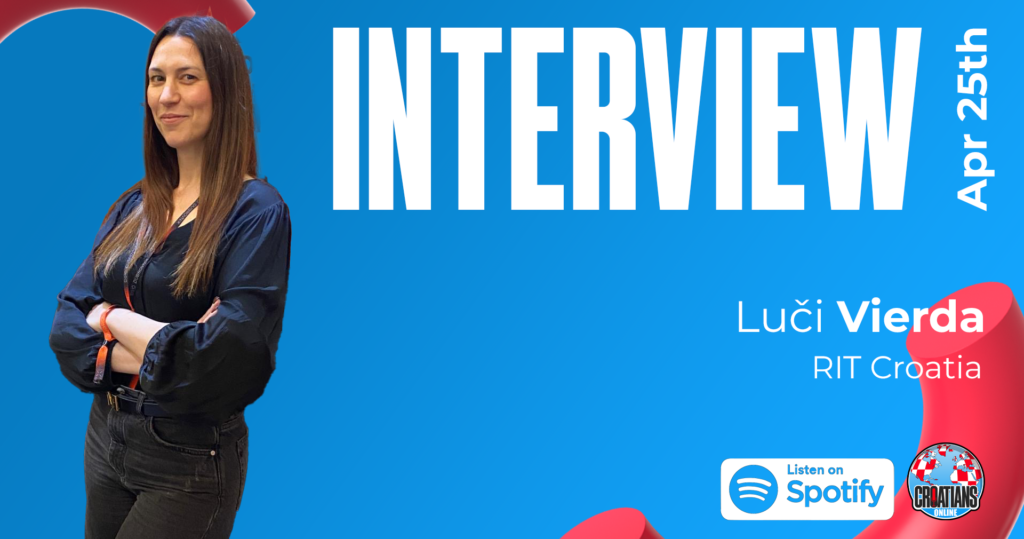
Imagine studying in Dubrovnik, doing an Erasmus semester in Barcelona, completing your co-op on Long Island – all under the umbrella of one university and one tuition fee. Too good to be true? Lucia Vierda, recruitment and enrolment specialist at RIT Croatia, broke it all down in a recent episode of the podcast Croatians Online.
Four programmes, two campuses, one double diploma
RIT Croatia currently operates campuses in Zagreb and Dubrovnik. In Dubrovnik, the oldest programme – Hospitality and Tourism Management – has been running since 1997, and was recently joined by Web and Mobile Computing. The Zagreb campus offers that same programme alongside Global Business Management and New Media Design, which just welcomed its very first graduating class this year.
But the announcement that drew most attention was a fifth programme: cybersecurity. “We haven’t started the application process yet, but we are very much looking forward to it,” Vierda said, noting that introducing any new programme is a lengthy process – it must be approved both by RIT and by Croatia.
“One of the best things about this college is that you have to do your co-op. Even if you pick the worst one, you’ll know: this is not for me.” – Lucia Vierda, RIT Croatia
Co-op: the edge most Croatian universities don’t offer
What sets RIT Croatia apart from most domestic universities is the mandatory work placement – the co-op – completed between the second and third year, and again between the third and fourth. Students choose where they do it: in Croatia, across Europe, in Rochester or in Dubai. The tuition fee does not change regardless of location.
Edita Erceg, an RIT Croatia graduate who now works in banking for Italy’s Intesa Sanpaolo, covering 12 European countries, is a living example of what that mobility can look like. “After my junior year I had the opportunity to do an international co-op, and I came to Long Island and worked at a golf and country club for a year and a half. I really love the international aspect and the diversity of people you meet,” she said.
Tuition: cheaper than a semester in Miami
For European students, the full academic year costs €7,800. For students from outside the EU the price is slightly higher – around €8,800. For comparison, a single semester at a good private university in New York can cost between $30,000 and $40,000, while out-of-state students in places like Florida can face bills of $90,000 to $100,000. “I cannot even imagine those prices,” Erceg said.
Students who go on exchange to Rochester or Dubai pay that same annual tuition – no hidden fees, no surcharges. When it comes to international students, the United States leads the way, followed closely by Montenegro. The student community also includes people from Bosnia and Herzegovina, Turkey, Germany, Austria, Azerbaijan, China and Canada. “Parents who aren’t ready to let their children go far from home find Dubrovnik ideal – it’s close, students can come back on weekends,” Vierda explained.
“In Croatia, we are the only ones offering a double diploma – American and Croatian. And that opens all the doors.”- Lucia Vierda, RIT Croatia
A master’s programme and an AI world moving fast
Beyond undergraduate studies, RIT Croatia also offers a master’s programme – Organizational Leadership – which comes directly from RIT rather than RIT Croatia. The conversation inevitably turned to artificial intelligence as well. “AI is developing faster than anyone expected,” Vierda noted. “That’s exactly why cybersecurity and hospitality are going to be the most sought-after programmes – those are the two things AI can’t easily replace.”
Every year, RIT Croatia organises a Career Education Day where alumni return to talk about their work and businesses – and to scout for new interns and employees. The alumni network stretches well beyond Croatian borders: one graduate now works for Care USA, one of the world’s largest humanitarian organisations.
Lucia Vierda and Edita Erceg had plenty more to say – about life in Dubrovnik, banking in Croatia, the double diploma advantage, and why farming might not be such a bad idea in the age of AI. Find Croatians Online on Spotify.
Listen to Croatians Online here:
Croatian American Media Association Corp is a tax exempt organization under Section 501 c(3) of the Internal Revenue Code (EIN # 99-1591741). Your donation is greatly appreciated and will be used to support our mission. Your contribution is tax deductible to the full extent permitted by law.