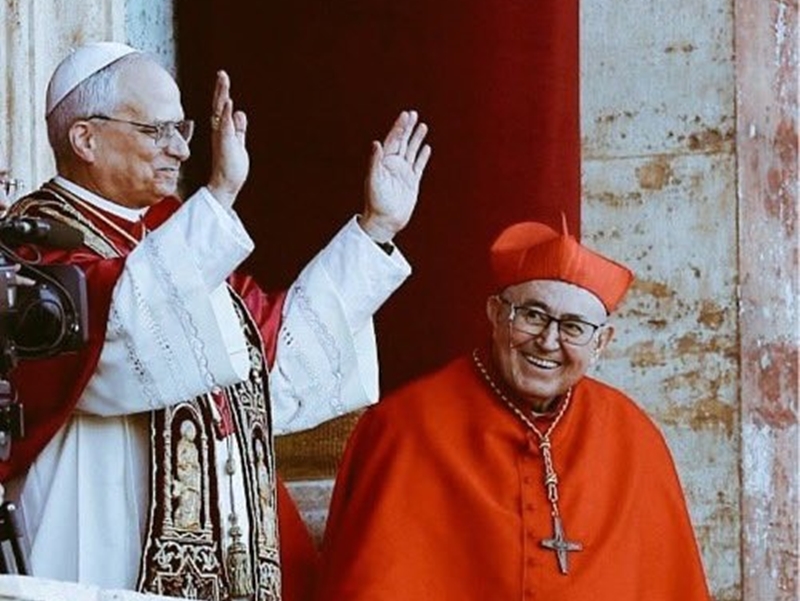

Catholics were astonished by the white smoke billowing from the smokestacks of the Sistine Chapel as the words “Habeum Papam,” which translates to “we have a pope,” were announced from around the world by Cardinal Protodeacon Dominique Mamberti. The conclave elected Cardinal Robert Francis Prevost to be the 267th Bishop of Rome, the “al-habbayit” or the father of the household prophesized by Isaiah. Cardinal Prevost has taken the name of Pope Leo XIV.
Pope Leo XIV, a native of Chicago, Illinois, is declared the first American pope and member of the Augustinian order.
Pope Leo XIV’s first words as pope were “Peace be with all of you,” and he addressed a beautiful homily during his first mass as pope in Latin, Spanish, and Italian.
“Allow me to extend that same blessing: God loves us, God loves you all, and evil will not prevail! All of us are in God’s hands. So, let us move forward, without fear, together, hand in hand with God and with one another! We are followers of Christ.” Addressed Pope Leo XIV.
His first appearance as pope from the balcony of St. Peter’s Basilica. Beside him were the two cardinals from his left: Archbishop Diego Giovanni Ravelli, Cardinal Pietro Parolin, and Cardinal Vinko Puljić.
As Croatians, as part of the Catholic community, were celebrating the newly elected pope, they were delighted to see Cardinal Vinko Puljić, the Archbishop Emeritus of Vrhbosna, of Sarajevo Bosnia-Herzegovina (BiH), who is a Bosnian Croat.
Croatian political scientist Ivan Pepić posted on X formerly known as Twitter, “Vinko Puljić, a Croat from BiH was created cardinal by Pope John Paul II in 1994. He was the longest-serving elector at the conclave. Some Western ambassadors told him that Croats in BiH must assimilate or emigrate. He has regularly spoken out against discrimination of Croats.”
Cardinal Puljić, who is well known for his conservative views and his indelible work in restoring peace to populations affected by the Bosnian conflict, almost did not attend the conclave due to an illness that prevented him from attending Pope Francis’ funeral and burial. At 79, he is one of the oldest Cardinals and participated in the 134 College of Cardinals that elected Pope Francis’ successor. Cardinal Puljić also joined fellow Croatian, Cardinal Josip Bozanić, Archbishop of Zagreb, in the conclave.
Cardinal Puljić has participated in two conclaves during the election of 2005 to elect Pope Benedict XVI, and in 2013 that elected Pope Francis. At the age of 49 in 1994, Pope John Paul II appointed him cardinal and worked tirelessly in assisting refugees fleeing the conflict.
“I have nothing to look for in deciding who to vote for,” the Croatian Cardinal said. “The Church is the work of the Holy Spirit. My role is to pray to the Holy Spirit, to be obedient to God’s Word, and to act in that spirit.”
On September 8th, the archbishop Emeritus will turn 80, thus losing his privilege to elect the next pope. His esteemed career as bishop and cardinal is known as a voice of reason, peace, and dignity for human beings regardless of race, religion, and creed. These values define the great theologians and saints in Croatia’s history despite challenges and setbacks from periods of war and ideological perversions, including communism, relativism, and gender ideology. The great man’s story is worth sharing, including his principles that are still in need of preservation by the gospels.
Vinko Pulijć was born on September 8, 1945, in Priječani in Banja Luka, Bosnia-Herzegovina, to Ivan and Kaja Puljić, both poor but devout Croatian Catholic parents. He and his family faced many difficulties under the Yugoslavian communist system that restricted mass attendance. During his youth, his spiritual formation was influenced by the Trappist Monastery in Marija Zvijezda. With the help of his father and Fr. Artner, Vinko was ordained into the priesthood.
In 1970, Cardinal Puljić was ordained to the priesthood, where he served in multiple roles, including as chaplain for the Diocese of Banja Luka and various parishes. He provided a sense of fatherliness to the seminarians and served as a confessor at the Benedictine monastery in Zadar where he organized spiritual retreats for priests, seminarians, and faithful women. He then became parish priest of Bosanska Gradiška in 1987.
On November 19, 1990, Puljić was then appointed Archbishop of Vrhbosna Sarajevo, where he served in the reconstruction of the ecclesiastical hierarchy in 1881, after the Ottoman Empire’s occupation of Bosnia lasted for four centuries. The name “Vrhbosna” has been used before Turkish rule.
The early 1990s became a tumultuous period for the Archbishop of Vrhbosna, where the former Yugoslavian republics witnessed the collapse of communism and sought to embrace freedom, democracy, and national sovereignty. Puljić’s work was directly focused on pastoral visits to the various Bosnian dioceses until his work was cut short due to the war breaking out in Croatia in August 1991 and eventually spreading throughout Bosnia- Herzegovina. During the war, he became deeply involved on the ground in administrating the evacuation of refugees and exiles while advocating for peace instead of further bloodshed by risking his life to visit war-tourn parishes and administer dialogues between Catholics, Orthodox, and Muslim leaders to promote unity and mutual respect of the inalienable rights of the human being. He was once imprisoned for twelve hours in the Serbian-controlled Ilidža, near Sarajevo.
Despite opposition to his positions, he received critical esteem for his role in advocating for peaceful coexistence among the various ethnic and religious communities in the region.
Two years before his appointment as Cardinal, Pope John Paull II wrote a letter addressed to all of the Bishops of Bosnia-Herzegovina: “When I imposed hands on you on January 6, 1991, to consecrate you in the office of Pastor of the Church of Sarajevo, I had no idea that very shortly your cross would be so heavy and your cup so bitter.”
The following year, he was appointed president of the Council of Bishops Conference in Bosnia-Herzegovina and served as president for three terms. During his terms, he has fought restlessly to address the permeating discrimination of Catholic Croats in Bosnia-Herzegovina. In 2010, the Bosnian Croat Cardinal faced a legal battle over his apartment in the bishop’s residence from the Federal Tribunal of Sarajevo so they could be given to heirs of communist spies. He strongly resisted the eviction and gained support from various media outlets and local communities, but the state authorities capitulated to the side of the communists.
As he supported embracing peaceful relations with the Bosniak Muslim communities, Cardinal Puljić has also vocalized the declining populations of Catholics in Sarajevo in what he has stated that it has become “solely a Muslim city.” He addressed this as a form of imbalance of representation, where Muslim communities are allowed to construct mosques throughout the region. Catholic churches need at least 12 years to approve permission to establish one church. He also stated that large investment sums from Arab countries have caused corruption within the government and over-expansion of Islamic influences in the region. Especially to blame for these discrimination issues are actions caused by indifference from previous High Representatives of Bosnia-Herzegovina and Islamic favoritism and victimization from the international community.
Cardinal Puljić’s principles align with the original teachings of the Gospels. He strongly condemns same-sex marriages and blessings of same-sex unions. When asked about whether Catholics in his Archdiocese of Sarajevo engage with progressive issues enshrined in the German Synodal Way, including women’s ordination and blessings of same-sex couples, he stated, “A Church that has weathered the challenge of communism does not have such exotic ideas. Indeed, such attitudes offend and astonish our believers. We cannot understand a Church in which sacrifice is a foreign word, and there is a Jesus without a cross.” His teachings address what the Catholic Church should emphasize in the original gospels instead of secularism and relativism. His presence with Pope Leo XIV and the Church serves as a beautiful example of the strong connections that Croats have with the Holy See.
Listen to Croatians Online here:
Croatian American Media Association Corp is a tax exempt organization under Section 501 c(3) of the Internal Revenue Code (EIN # 99-1591741). Your donation is greatly appreciated and will be used to support our mission. Your contribution is tax deductible to the full extent permitted by law.