Economic relations between the United States and Croatia are being tested due to the recent order coming from the White House.
Croatia’s membership path in the Organization for Economic Co-operation and Development (OECD) has been temporarily blocked. The temporary halt was ordered due to tariff conflict between President Trump and the European Union (EU).
Croatia began negotiations with the OECD back in 2022. Since then the membership process has been doing very well in to reach at least 19 out of the 25 committee bodies and was expecting to complete the technical portion of the accession. The OECD membership process was established as a forum to improve data, analysis, and best practices in public policy to build positive economic growth and improvements in the environmental sector, market competition, agriculture, trade, shipbuilding, and various industries. It was also an opportunity for Croatia, supported by Foreign Minister Gordan Grlic Radman to achieve its national goals faster and stimulate trade and investment, encourage innovation, improve tax systems, improve public administration efficiency, education, and labor market policies to sustain economic growth.
Croatian’s accession would also guarantee numerous reforms in the country to strengthen legal security for EU funds to be invested in local businesses and for everyday citizens, including strengthening the country’s outreach to attract foreign investors. One of the main countries that play an effective role in advancing these pursuits for improved business channels for investors is the United States.
Right now, Croatia’s blocked from membership is part of a complicated situation where the EU potentially will face 25% tariffs from the Trump Administration on aluminum and steel imports.
In response, EU countries are seeking counterbalance measures to challenge these “unjustified” tariffs.
Instilling tariffs on the EU, if done recklessly, would increase prices on American consumer goods in the EU and dampen American companies from investing in these countries. However, if done strategically they have been used as a negotiating tactic to help leverage a deal to meet the ends for better access to markets, better diplomacy, and improved security policies. These tariffs could potentially serve as a similar mechanism to remove imbalances in tax systems in the global markets that limit the benefits for American industry. President Trump used tariffs as a method to suppress the EU’s push to establish a carbon and digital-service tax aimed at American industries to protect companies, including tech industries, from “unfair and discriminatory taxation practices.
The situation rests on Trump’s comment where he said the EU was formed “to screw the United States” due to the EU value-added tax of at least 17.5% on steel and aluminum for motor vehicles. While economic analysts are saying that unilateral trade wars are unnecessary, they could provide leverage to ensure an even playing field in the markets for US production that faces double taxes on exported products.
Croatia, an EU member, could be positioned to engage in countermeasures against Trump’s tariffs and eventually complicate relations that would delay pending treaties and revoke existing policies with the United States. Despite these halts in the OECD membership, Croatian ministers are optimistic that a deal with the U.S. can be reached.
Zdenko Lucic, State Secretary at the Ministry of Foreign and European Affairs stated, “The vote in the trade committee will take place when conditions allow. We are working closely with our American partners and the OECD on all issues concerning our entry.”
Lucic also commented that if the vote does not happen this year, better luck next year, expressing that the membership block for the OECD was just a flesh wound and a not serious blow to Croatia. However, this block could dampen the progress of the United States to finalize the Avoidance of the Double Taxation Treaty (DTT), the long-anticipated agreement that has left Croatian ministers impatient with American officials and Croatian Americans frustrated about its status.
Since its signing on December 14, 2022, the DTT has awaited ratification in the Senate. In the past, treaties made by foreign parties could take about a decade or more to be ratified and require a 2/3 majority for it to formally pass. Due to legislative concerns about tax security and language harmonization with additional DTT treaties, especially with Chile, concerning rare earth minerals, the DTT for Croatia is currently stuck in limbo at the U.S. Treasury and has remained there since the Biden Administration.
According to Congressman David Joyce, Co-Chair of the Congressional Croatian Caucus, the problem now lies in the changes in Congress and the Treasury Department. “When this was first brought up in 2022, there was a different administration that wasn’t particularly interested in these matters,” the congressman said.
Without the ratification of the DTT, Croatian businesses will be hindered from fully accessing American markets and products without being double-taxed. It will also hurt American companies operating in Croatia which could be burdened by double income taxation. Croatian companies in IT, pharmaceutical, and food industries with investments in the U.S. markets will be hurt the most, including American citizens living abroad who currently face double tax burdens on income, property, and additional U.S. requirements of citizenship taxes. Croatian Americans will continue to be harmed financially if inaction in the movement in the DTT continues in the U.S. Treasury.
During his campaign trail, President Trump pledged to “end double taxation of American living and working abroad,” where at least 8 million Americans continue to live and work aboard. Although not much was said it was a step in the right direction for overseas Americans, especially retirees who are affected the most.
Croatia and the United States have a long history of strong diplomatic relations. But due to the brazen exchanges between Ukrainian President Zelenskyy and the Trump Administration, plus its geopolitical shifting interests in the Indo-Pacific, there is still uncertainty about stabilizing future relations with Croatia. The status of these cherished relations remains to be uncertain. However, provocations in the U.S.’s potential departure of NATO could pose a serious problem and escalating trade wars that could drive EU officials from complying to negotiate with U.S on economic and security policies.
Croatia will ultimately be affected by EU officials’ inactions from meeting with their suggested counteroffers to reduce imposed value taxes and efforts to revitalize their security guarantees and a structured defense policy without the United States. Since the EU has yet to develop a war economy to deter Russian aggression against Ukraine and still relies on a peacetime civilian economy, its capability to unify as a reliable institution will be a great challenge for its members.
Trump’s tariffs, if used properly, can serve as a wake-up call for EU officials to strengthen their unity to prioritize their security measures and economic needs. They can also be implemented to salvage the declining relations between Trump and Europe by eliminating double value and service taxes on exports that disincentivize U.S. investments. However, Trump must implement them to allow channels for diplomacy and not delay or cancel existing agreements with member nations, especially with Croatia.
U.S. agreements with Croatia, including the Visa Waiver Program and defense cooperation with the U.S. military, strengthen these strategic bilateral partnerships and ensure Croatia’s economic growth and modern security capabilities to defend its borders. It will be a strategic disaster if these treaties are hindered and abandoned. The tentative actions to forward the DTT have already shown how such delays endanger relationship building. President Trump must push the Treasury Department to deliver his campaign promise. Additionally, the tentative responses from the EU can be disastrous for Croatia and hostile responses against the U.S. could cause more collegial damage than the temporary halt on Croatia’s OECD membership, the DTT inaction, and Trump’s tariff threats.
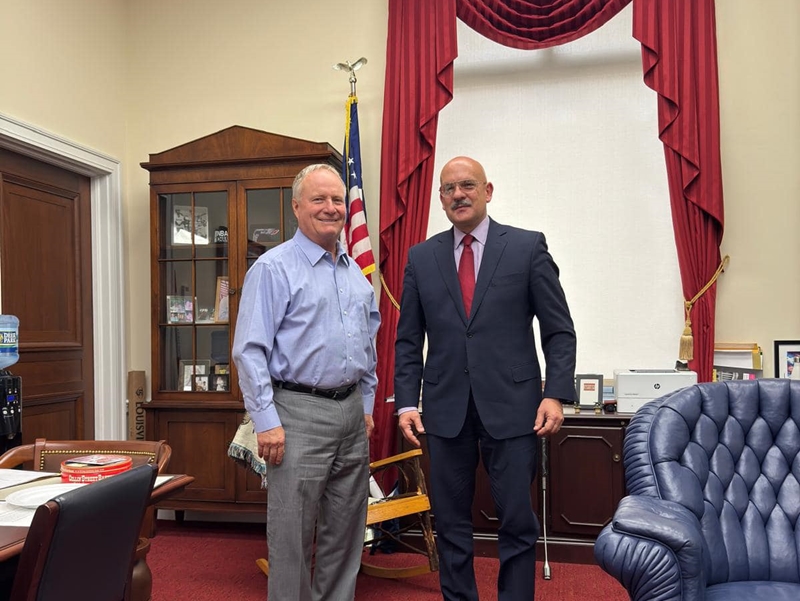
Photo: Croatian Embassy in Washington D.C.
Listen to Croatians Online here:
Croatian American Media Association Corp is a tax exempt organization under Section 501 c(3) of the Internal Revenue Code (EIN # 99-1591741). Your donation is greatly appreciated and will be used to support our mission. Your contribution is tax deductible to the full extent permitted by law.